My name is Marc Lagace, and thank you for stopping by and checking out my blog
I am a CreComm student at Red River College. With this blog, I plan on exploring and sharing everything that I find funny; from stand-up comedians, television and movies, YouTube and Vine and anything that falls in between. I hope to also explore the local comedy scene and talk with up-and-coming Winnipeg comedians about writing and performing in the City.
End goal: Work on my own material and work up the courage to take the stage at an open mic. Then, once the comedians accept me as one of their own, I shall set up a pyramid scheme and eventually retire to the Cayman Islands.
Firstly, Happy Halloween everybody. I know it’s technically two days after Halloween, but since it fell in the middle of the week, I think we get to celebrate it both the weekend before and the weekend after… SWEET.
This year, I put together a Han Solo costume.
Following along with the Star Wars theme, I feel compelled to share perhaps my favourite YouTube series produced by RedLetterMedia. Created by independent filmmaker Mike Stoklasa, RedLetterMedia’s most famous videos are its sci-fi reviews, which are channelled through a character of Stoklasa’s creation: Harry S. Plinkett.
I could describe Plinkett, but that would ruin most of the fun. Plinkett reviews the prequel Star Wars films in epic, almost feature-length videos; the review for Phantom Menace clocks in at nearly 70 minutes. That might seem a tad excessive, but trust me when I say that Stoklasa blends absurdly dark humour with a very intelligent argument as to why the prequels are an abomination to not only the Star Wars franchise, but to filmmaking in general.
You can checkout the Phantom Menace, Clone Wars and Revenge of the Sith reviews on their website, or through their YouTube channel. I’ve also embedded part one of the Phantom Menace review below. Check it out!
His latest project is The Birthday Boys, a sketch show that prominently features the LA sketch comedy troupe of the same name. How convenient!
So far, two episodes have been aired, and they have both been pretty awesome. The writing is on point and although I’m not familiar with The Birthday Boys’ previous work, Odenkirk has never led me astray yet.
You can catch The Birthday Boys on Fridays at 9:30c on IFC, or if you can’t catch it or don’t have IFC on your cable package, I hear that there are other means to acquire a digital copy of the programme.
Not that I would know anything about that shady side of the internet…
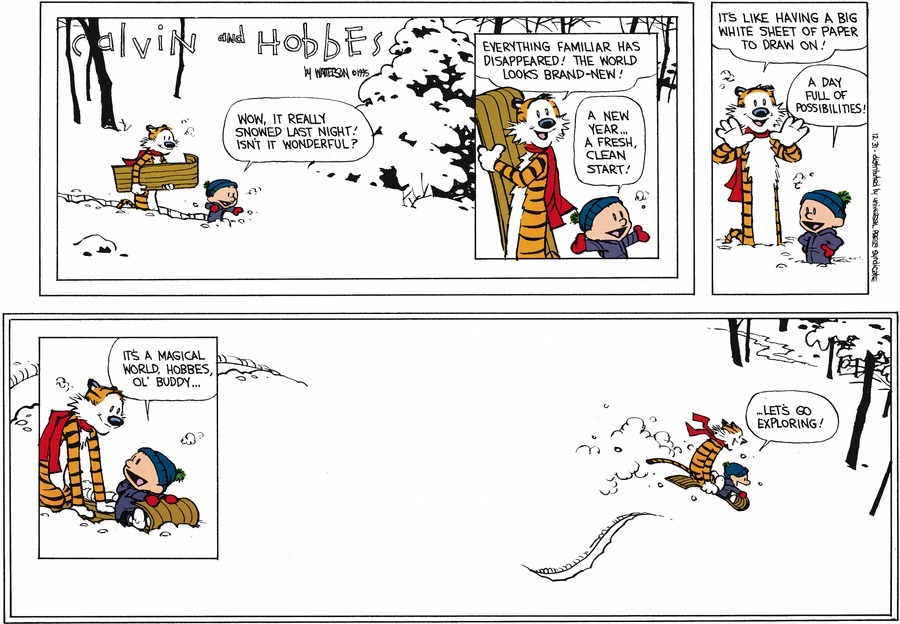
The final Calvin and Hobbes comic strip. Published Dec. 31, 1995. Via: GoComics.com
If your only exposure to Calvin and Hobbes has come from seeing Calvin pissing on a Ford or Chevy logo in the back window of a pickup truck, then WHAT IS WRONG WITH YOU?
Calvin and Hobbes ran in newspapers from 1985 until December 1995, and is arguably the greatest comic strip of all time. I can say that because I will argue that point until I die.
Cartoonist Bill Watterson had this wonderful way of depicting Calvin’s imagined worlds, and transitioning in and out of reality. Much like The Simpsons, Watterson’s work was able to connect with both younger and older audiences. Having read most of Calvin and Hobbes as a kid, I’ve enjoyed re-reading them all as an adult. The entire series has been archived at GoComics.com.
Bill Watterson has been notoriously reclusive, and extremely protective of the original source material. Thats what makes the interview he did withso interesting. You can read it here:
Like every other well-balanced 20-something of my generation, my childhood years were defined by watching The Simpsons. I distinctly remember how important it was to have watched Sunday’s episode so that you could talk about it at school on Monday. This would have been during the tail-end of what is considered the “golden age” of The Simpsons (Any episode from the first eight seasons.)
Now, considering I was only one-year-old when the first season originally aired, I actually caught up on most of the earlier episodes through syndication, which allowed The Simpsons to air five days a week immediately after school. The beautiful genius of The Simpsons was that their comedy audience included both children and adults, and somehow the jokes managed to hit for both demographics. Now as I revisit the earlier episodes for the 50th time (it feels like), I’m finally able to appreciate all the literary, film and other pop-culture references that made the show so great.
I’ll make a point to catch any old rerun of The Simpsons.
However, I can’t recall the last time I’ve sat down to catch a new episode live on Sunday night. Part of that could be that I’m just too busy to find the time to sit down and watch it on Sundays. But the bigger issue is…
The Simpsons really shouldn’t be making new shows on television anymore.
As a bit of an aside, I’ve been working on this post for a while now. I was planning on posting my thoughts on the state of The Simpsons last week, but I felt that it would end up being more of an opinionated rant than anything backed up with facts or first-hand accounts from people who know what they’re talking about. I remembered talking about the decline of The Simpsons with Leif Larsen at the Manitoban offices a few years ago, and he recommended reading The Simpsons: An Uncensored, Unauthorized History by John Ortved. So I read it.
For a fan of the series looking to get a better insight into the creation of The Simpsons and rise to prominence should certainly check the book out. The format can be hard to follow, as there are lengthy quotes from showrunners, producers and writers of the first eight seasons, but the quotes are also the most interesting parts of the book.
Anyways, based on the information presented in the book, you can track the transition from the ‘golden age’ based on the transitions between show runners. For the first eight seasons, there were four different showrunners (sometimes in groups of two or three). Casual fans might not recognize names like Sam Simon, Al Jean or David Mirkin, but they were the men tasked with producing the show and keeping the writer’s room in line.
(Stories from the writer’s room was the most interesting part of the book, by the way. Especially the chapter on Conan O’Brien, but I might be somewhat biased because I’m a huge Conan fan.)
Anyways, Looking at the first eight seasons, each showrunner got two seasons in charge. Then, Mike Scully took over for season nine and stayed on from 1997-2001. His run was followed up by Al Jean, who has been The Simpsons showrunner ever since, as the show heads into it’s 25th season (!) this year.
Now, part of the reason why The Simpsons will never be as good as the golden-era episodes is simply because back in the early 90s, the show was still fresh, controversial and new. The characters (especially the humongous cast of secondary characters) had not gone through “Flanderization”, which, according to TVTropes.org:
The act of taking a single (often minor) action or trait of a character within a work and exaggerating it more and more over time until it completely consumes the character. Most always, the trait/action becomes completely outlandish and it becomes their defining characteristic. Sitcoms and Sitcom characters are particularly susceptible to this, as are peripheral characters in shows with long runs.
Named for one of the examples in The Simpsons, Ned Flanders, who was originally just a considerate neighbor and attentive father (contrast to Homer), before becoming obsessively religious to the point of lunacy.
That will almost force the writers to have to try and find topical material to write about, or to go with more outlandish story ideas. And in the fifth and sixth seasons, when Homer went to space, Bart got an elephant and the Simpson family creates an international event in Australia, these wacky adventures were the exception, not the rule.
But maybe it was the two-parter “Who Shot Mr. Burns?” episode where the show hit one of its highest marks in popularity and hype, while at the same time jumping the shark as a series.
Here’s a test for anyone who considers themselves a Simpsons fan. Go through the full episode list (all 500+ episodes), from season one to season 24, and just based on the titles, see how many episodes you recognize—whether it’s the plot or specific jokes and gags that have stood the test of time. You’ll realize just how stacked the first eight or nine seasons are, compared to the next 15 seasons.
You can also see just how over-the-top the stories became. Even though it’s always been a cartoon with an often absurd and satirical sense of humour, the early episodes were always grounded in it’s own version of reality. Now check out this entry from Wikisimpsons on the upcoming season.
An episode dedicated to Kent Brockman? Comic Book Guy getting married? A Futurama/Simpsons crossover episode?
Anyways, the one thing that I think fans, former-fans, or haters can all agree on is that whenever The Simpsons mercifully comes to an end, it will be an emotional series finale. For millions of people around the world (myself included).
The Simpsons have been there throughout my entire life. And just like something you sort of take for granted after a while, as much as it’s been played out and deserves a respectable close, it will be a sad day when The Simpsons comes to an end.
But the time has come…and passed… and will come again. Al Jean, speaking to Entertainment Weekly, says he hopes to get to 30 seasons by the end of the decade. So it doesn’t seem like The Simpsons will be ending any time soon.
But at least we can all look forward to reruns, which will probably air on television until the end of time.
When I first started using Vine, I didn’t quite know what to expect. It was a neat app with some challenging restrictions. You have six seconds of time per video, recording by touching your iPhone screen, with no opportunity to see what you got until you’ve finished and no opportunity to edit.
What I quickly discovered is that there was a small but growing Vine community of funny people posting some very funny six-second short films. If you’re familiar with the YouTube channel 5secondfilms, you will know that it is entirely possible to be hilarious in such a short amount of time.
One of the funniest people I’ve found on Vine was Bill Stiteler, a 24-year-old stand-up comedian living in New York. What made his vines stand out was his use of crude animation to take Vine into more of the realm you would find with 5secondfilms. You can check out all his vines at this site here, but I would definitely recommend following him on his Vine account through the app as well.


 Hello, I'm Marc Lagace!
